In Their Own Words
In Their Own Words
Humour
“I have spent my whole life making the word ‘stress’ famous, only to realize I picked the wrong word from the dictionary!”
In physics, stress is the force applied, while strain is the result on the object. Selye realized he had actually been studying the “strain” on the body all along. Because he was Hungarian-born and learned English later, he famously lamented that if his English had been better when he started, he would have called the phenomenon “strain” instead of “stress.” Selye viewed humor as a biological safety valve. He believed that the ability to laugh was one of the most advanced adaptation techniques the human nervous system ever evolved.
What were his professional activities?
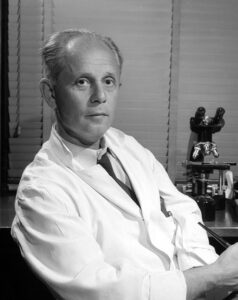
Hans Selye’s professional life was exceptionally productive and multifaceted in his approach to science. Based at the University of Montreal, he founded the Institute of Experimental Medicine and Surgery in 1945, transforming it into a premier global research hub. His extensive laboratory work led to the landmark discovery of the General Adaptation Syndrome (GAS), identifying the three stages of stress: alarm, resistance, and exhaustion. Beyond GAS, he pioneered research into corticoids and their roles in inflammatory diseases.
Selye’s activities extended far beyond the laboratory through his prolific writing, which included 39 books and over 1,700 scientific articles. His bestsellers, The Stress of Life and Stress Without Distress, translated complex biological feedback loops into a vernacular that reached mainstream audiences worldwide. As a highly sought after lecturer and communicator, he traveled globally to bridge the gap between high level endocrinology and public understanding.
Selye trained hundreds of researchers and collaborated across diverse disciplines, including systems science and philosophy. His immense impact is reflected in his 43 honorary degrees and 17 Nobel Prize nominations, cementing his legacy as a foundational figure who moved medicine away from fragmented, organ-specific studies toward a unified, systemic view of human health.
How did he contribute to Canada’s systems thinking literacy?
- Institutional Leadership: At the University of Montreal, he founded a premier research center that served as a global hub, training international scientists in a multidisciplinary, integrated approach to the human body.
- Systems Framework: His “General Adaptation Syndrome” introduced the concept that health is an outcome of complex interactions between the endocrine, nervous, and immune systems.
- Core Concepts: By focusing on interdependence, regulation, feedback loops, and adaptation, he normalized the foundational principles of systems science within Canadian medicine and culture. He redefined biology and stress as integrated, whole -system processes.
- Public Engagement: Through best-selling books and media appearances, Selye translated complex laboratory science into accessible language, teaching the public to view health as a systemic balance.
- Intellectual Hub: Alongside pioneers like Ludwig von Bertalanffy, Selye’s work helped establish Canada as a primary center for the study of complex, self-organizing systems.
Did Hans’ work positively influence Canada’s K-12 education, directly or indirectly?
Hans’ work has had a profound indirect influence on Canada’s K-12 education system by providing the physiological evidence required to prioritize student well-being.
- Development of Social-Emotional Learning (SEL): Selye’s concept of the stress response is the scientific bedrock for provincial SEL frameworks. By understanding how the body reacts to pressure, educators have moved beyond discipline toward teaching self-regulation and resilience.
- The Eustress framework: Teachers use Selye’s concept of eustress (positive stress) to design healthy academic challenges that motivate students without triggering the exhaustion phase of General Adaptation Syndrome.
- Mental health policy: His research helped destigmatize mental health in Canada, leading to the integration of wellness into the core curriculum. This shift treats stress management as a vital life skill rather than an extracurricular luxury.
- Brain-based learning: Selye’s findings on how chronic distress impairs the hippocampus, and thus memory, have influenced modern pedagogical strategies that prioritize a low-threat, high-challenge classroom environment to maximize cognitive performance.
What were his contributions to systems thinking?
Hans Selye’s contribution to systems science lies primarily in his shift away from linear medical thinking toward a wholistic, organism-wide perspective. Before Selye, medicine largely followed the “specific etiology” model, which sought a single specific cause such as a germ for every specific disease. Selye’s General Adaptation Syndrome (GAS) challenged this by proving that the body possesses a coordinated, non-specific system to maintain internal balance, or homeostasis regardless of the type of threat.
Selye’s work provided a biological foundation for General Systems Theory, championed by his contemporary Ludwig von Bertalanffy. While Bertalanffy worked on the theoretical framework of systems, Selye provided the empirical evidence of a biological system in action. He viewed the human body as a complex, self-regulating circuit where the endocrine system, the nervous system, and the immune system functioned as an integrated network. If one part of the system became overtaxed, the “exhaustion” phase, it led to “diseases of adaptation”, a concept that is fundamentally systemic because it views illness as a failure of the body’s regulatory feedback loops rather than an isolated external attack.
Selye expanded his systems thinking into the social and philosophical realms. In works like Stress Without Distress, he proposed Altruistic Egotism, a systems-based code of conduct designed to minimize social friction. He argued that individuals are subsystems within a larger societal system, and that for the whole to remain healthy, the parts must function in a way that minimizes distress for the collective. This systemic view of human health, linking cellular biology to social behavior, remains his most enduring intellectual legacy.
AI generated and reviewed with multiple brands