

In Their Own Words
Humour
“I have reached an age where my feedback loops are starting to have significant time-lags.”
In engineering, a “time lag” in a feedback loop usually leads to instability or oscillation in a system; by applying this to his own aging body and mind, he was poking fun at his slowing reflexes while remaining a “systems man” to the core. Arthur was known for his wit and charm in academic circles and he frequently quoted or paraphrased his friend Marshall McLuhan, whose puns and probes he found deeply amusing. He particularly enjoyed McLuhan’s paradoxical style, which Porter viewed as a humorous way to reveal the invisible systems surrounding us.
Professional Activities
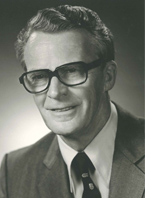
Arthur Porter was a polymath whose professional career bridged the worlds of physics, early computing, and industrial engineering. He gained early prominence in the 1930s by collaborating with Douglas Hartree to build the Differential Analyser, one of the world’s first analog computers, using Meccano components. From 1937 to 1939, Porter completed a post-doctoral fellowship at MIT, U.S.A. During World War II, his expertise was utilized by the British Admiralty for research into radar and anti-aircraft predictors.
In the post-war era, Porter worked as the Director for Research at Ferranti Electric in Toronto, Canada. He later became a pivotal figure in Canadian academia and served as the Dean of Engineering at the University of Saskatchewan before moving to the University of Toronto where he founded the Department of Industrial Engineering. A pioneer of cybernetics, he famously collaborated with Marshall McLuhan, providing the scientific framework for McLuhan’s theories on media and technology.
Porter was a significant public intellectual. He chaired the Royal Commission on Electric Power Planning, titled the Porter Commission, in Ontario from 1975 to 1980 shaping the province’s energy policy. For his contributions to science and education, he was appointed an Officer of the Order of Canada. His career was defined by an interdisciplinary approach, linking the hard sciences with the humanities to understand technology’s impact on society.
Contributions To Canada’s Systems Thinking Literacy
- Academic leadership: He founded the University of Toronto’s Department of Industrial Engineering, introducing a curriculum that treated organizations as integrated human-machine systems.
- Cultural integration: Collaborating with Marshall McLuhan, he applied cybernetic concepts like feedback loops to media theory, bridging the gap between engineering and the humanities.
- Public policy: Through the Porter Commission, he educated the public and government on viewing the electrical grid as a socio-technical system where energy, environment, and society intersect. His membership in the Canadian Association for the Club of Rome was essential to his later life advocacy for long-term systemic thinking regarding the earth’s resources.
- Interdisciplinary advocacy: He promoted a wholistic literacy, teaching Canadians to manage complex, large-scale systems by balancing technical logic with human values. Inducted to the Canadian Science and Engineering Hall of Fame which recognized his status as a “Renaissance Man” of science and a pioneer in several critical fields.
- Intellectual convergence: Porter recognized that Jay Forrester was doing with digital computers what he had tried to do decades earlier with analog computers (the Differential Analyser). Porter served as a key bridge, translating Forrester’s complex system dynamics for Canadian policymakers and academics.
- Officer of the Order of Canada: Appointed for his work at the University of Toronto and his leadership of the Porter Commission (The Royal Commission on Electric Power Planning), which was one of the most significant applications of systems thinking to public policy in Canadian history.
Did Arthur’s work positively influence Canada’s K-12 education, directly or indirectly?
Arthur influenced Canada’s K-12 education primarily by advocating for systems thinking and technological literacy as essential life skills. His impact includes:
- Interdisciplinary curriculum: By bridging the Two Cultures (science and humanities), Porter encouraged a holistic approach to education. This influenced the shift toward integrated curricula where students study the social impacts of technology, rather than just technical mechanics.
- Early computer literacy: His leadership at Ferranti and the University of Toronto helped establish Ontario as a global tech hub. This indirectly accelerated the introduction of computer science and logic-based problem solving into high school vocational and academic programs.
- Systems thinking in pedagogy: Porter’s cybernetic principles, emphasizing feedback loops and learning how to learn mirrored the mid-century shift toward student-centered, inquiry-based learning in Canadian public schools.
- Media literacy: Through his collaboration with Marshall McLuhan, Porter provided the hard science backing for media studies. This helped solidify media literacy as a core component of the Canadian English and Social Studies curriculum, teaching students to analyze the invisible systems of digital environments.
Contributions To The Global Systems Thinking Discipline
Porter was a key figure in the early global systems thinking movement by evolving cybernetics from a technical engineering tool into a wholistic framework for understanding society.
Porter applied cybernetic principles such as feedback loops and control theory to non-mechanical fields like economics and biology. He belonged to the generation that built the tools and theories (the Differential Analyser and feedback math), that Jay Forrester decades later integrated into the formal discipline we now call System Dynamics.
As a key collaborator with Marshall McLuhan, Porter provided the scientific rigor for the Toronto School of Communication, framing technology and media as complex, interconnected systems that reshape human environments.
Porter revolutionized Industrial Engineering by shifting its focus toward human-machine systems. By integrating psychology and social variables into engineering, he established an interdisciplinary approach to technical education.
Through the Porter Commission on electric power planning, he applied systems thinking to public policy. He treated the electrical grid as a sociotechnical system balancing technical needs with environmental health and public opinion.
Porter’s legacy lies in the democratization of cybernetics, bridging the gap between the hard sciences and the humanities to better manage the large-scale, complex systems of the modern world.
AI generated and reviewed with multiple brands