

In Their Own Words
Humour
“Deepness is usually a sign of lack of light.”
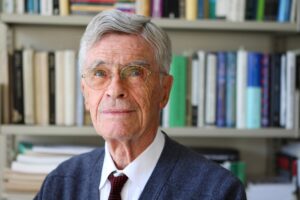
This was Bunge’s most famous humorous quip. He used this to target philosophers who used obscure language. He argued that if a thought was “deep” (muddy/unclear), it was simply because the thinker hadn’t turned the light of logic on it yet. In his late 90s, when asked about his secret to a long life, he would often dryly reply with a line that became a favorite among his students. “The secret to a long life is to keep breathing” which he followed by clarifying that the secret was to never stop working.
Professional Activities
Mario Bunge’s professional activities were characterized by an almost unmatched polymathic range, spanning physics, philosophy, and the social sciences. His primary role was as the Frothingham Professor of Logic and Metaphysics at McGill University (1966–2010), where he taught and mentored generations of scholars. However, his work extended far beyond the classroom.
Bunge was a relentless public intellectual and activist for science. He was a founding member of the Society for Exact Philosophy, and a fellow of the Committee for Skeptical Inquiry, where he spent decades debunking pseudosciences like psychoanalysis, homeopathy, and postmodernism. He was deeply involved in international scientific governance, contributing to the Club of Rome and the International Academy of Philosophy of Science.
In his native Argentina, he founded the Universidad Obrera Argentina (Argentine Workers’ University) in 1938 to provide science and technology education to the working class. Until his death at age 100, Bunge remained a prolific author of over 500 papers and 80 books, maintaining an active schedule of international lecturing and caustic critique of intellectual dishonesty.
Contributions To Canada’s Systems Thinking Literacy
- Philosophical rigor: He transformed systems thinking from a fringe New Age concept into a rigorous academic discipline by integrating it with mathematical logic and scientific realism.
- The CESM Model: He provided Canadian scholars with a clear analytical toolkit (Composition, Environment, Structure, Mechanism) to deconstruct complex global and local systems.Transdisciplinary Leadership: By bridging McGill’s science and philosophy departments, he broke down siloed thinking, influencing Canadian approaches to medicine, sociology, and law.
- Mentorship of policymakers: He trained decades of Canadian intellectuals and public servants to view social issues as systemic social technologies rather than isolated political events.
- Defence of science: He bolstered national scientific literacy by teaching Canadians to distinguish between genuine systemic science and pseudoscience, advocating for evidence-based policy at the highest levels.
Did Mario’s work positively influence Canada’s K-12 education, directly or indirectly?
Mario Bunge’s influence on Canadian K-12 education is particularly distinct due to his long tenure at McGill University and his role as a public intellectual in Canada.
- Evidence-based pedagogy: Bunge’s Scientific Realism serves as a bulwark in provincial curricula against pseudoscience. His philosophy reinforces the Canadian emphasis on inquiry-based learning that remains grounded in objective, peer-reviewed facts.
- Systems thinking in Geography: The Canadian Social Studies curriculum utilizes Bunge’s Systemism to teach students how human and physical systems, such as urban development and the Canadian Shield, interact and influence one another.
- The Science-Technology-Society-Environment (STSE) Model: Many Canadian provinces use STSE frameworks. This reflects Bunge’s sociotechnology, treating technology and policy not as isolated tools, but as social interventions with systemic environmental impacts.
- Digital literacy: Bunge’s skepticism informs Canadian “Media Literacy” standards, which encourage students to use logic and materialism to dismantle “fake news” and non-scientific claims.
- Ethical Social Studies: His systemic ethics align with the Canadian focus on global citizenship, teaching students that individual actions are nested within larger national and global systems.
Contributions To The Global Systems Thinking Discipline
Mario Bunge transformed systems thinking by transitioning it from a vague, metaphorical concept into a rigorous, mathematically grounded framework. He rejected the extremes of individualism (only parts exist) and wholism (the whole is an irreducible mystery), proposing instead Systemism. This philosophy, detailed in his massive eight-volume Treatise on Basic Philosophy, bridges the two views by analyzing every system through the CESM Model: its Composition, Environment, Structure, and Mechanism.
As a critical link between the natural and social sciences, Bunge was an active voice in the Club of Rome circles. While he supported modern computer simulations and global forecasting, he insisted they be grounded in realist ontology rather than treated as black boxes. He viewed global entities, such as the world economy and the environment, as nested subsystems interacting through specific physical and social processes.
Bunge treated philosophy as an exact science, eventually pioneering Systemic Ethics. He argued that global crises including poverty and environmental degradation cannot be solved through individualistic ethics alone. Instead, he advocated for a “sociotechnical” approach, treating policy-making as a form of social technology. His legacy lies in providing the philosophical foundation for transdisciplinary research, proving that global problems require a unified systemic worldview.
AI generated and reviewed with multiple brands