

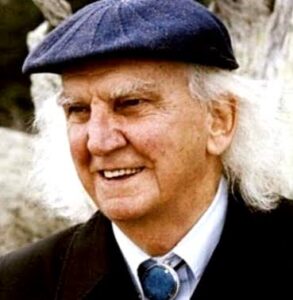
In Their Own Words
Humour
“Anyone who believes exponential growth can go on forever in a finite world is either a madman or an economist.”
Boulding was legendary for his wit and “Bouldingisms.” The above is his most famous quote that is a cornerstone of environmental and systems thinking. Boulding viewed humor as an essential tool for intellectual humility and a vital “lubricant” for social systems.. The most serious institutions like the military or the banking system were often the most unintentionally hilarious. Humor allowed him to say “The emperor has no clothes.” regarding economic policies that ignored human or environmental costs. He believed a person who could laugh at their own theories was still capable of learning, and was a primary method for discovering truth and connecting the intellect with the spirit.
Professional Activities
Kenneth Boulding was a polymath who devoted his entire professional life to the pursuit of interdisciplinary synthesis. Primarily trained as an economist, he held prestigious academic posts at the University of Michigan and the University of Colorado Boulder. His work in economics was transformative as he sought to move the field away from static, mechanical models toward evolutionary economics treating social systems as living ecosystems. In 1968, his peers recognized his influence by electing him President of the American Economic Association.
Boulding was also a foundational figure in General Systems Theory. In 1954, alongside Ludwig von Bertalanffy and others, he co-founded the Society for General Systems Research. He was a bridge-builder, creating a shared language for scientists to understand complex structures across biological, social, and physical domains.
As a devout Quaker (some sources refer to him a mystic), Boulding was equally dedicated to peace research. He co-founded the Journal of Conflict Resolution and the Center for Research on Conflict Resolution. He applied systems thinking to international relations, arguing that peace is a stable system that can be studied and engineered.
His written words included over 30 books and hundreds of articles. He was a quintessential public intellectual, famously popularizing the “Spaceship Earth” concept to advocate for environmental sustainability. Whether serving as president of the American Association for the Advancement of Science (AAAS) or writing poetry to explain economic theory, Boulding’s career was a singular effort to integrate human knowledge into a wholistic understanding of the world.
Contributions To Canada’s Systems Thinking Literacy
- Provided a common systems language: Boulding’s advancement of general systems theory helped Canadian scholars think across economics, ecology, education, and policy.
- Introduced the hierarchy of system complexity: His framework gave Canadians a way to analyze simple and complex systems differently.
- Highlighted mental models: In The Image, he showed that people act on perceptions, improving systems literacy about behavior and decision-making.
- Supported interdisciplinary thinking: His work encouraged Canadian researchers to connect social, environmental, and institutional problems.
- Influenced sustainability thinking: His Spaceship Earth idea helped Canadians understand limits, interdependence, and resource stewardship.
Did Kenneth’s work positively influence Canada’s K-12 education, directly or indirectly?
Kenneth Boulding’s systems thinking has had a subtle but profound influence on Canadian K-12 education, particularly through the adoption of wholistic, interdisciplinary, and competency-based curricula.
- Integrated curriculum models: Provincial frameworks (notably in British Columbia and Ontario) have moved away from siloed subjects toward Big Ideas and Cross-Curricular Competencies. This reflects Boulding’s General Systems Theory, which emphasizes the common laws governing different disciplines.
- Environmental and global citizenship: Boulding’s Spaceship Earth concept is a cornerstone of Canadian social studies and science curricula. It teaches students to view the planet as a closed systemic web, fostering the systems thinking required for modern environmental education.
- Complexity and interdependence: The shift toward systems thinking as a specific 21st-century skill in Canadian classrooms helps students analyze feedback loops in history and biology, moving beyond simple linear cause-and-effect.
- Peace education: Through Elise and Kenneth’s joint influence, Canadian schools emphasize Social-Emotional Learning (SEL), treating the classroom as a social system where conflict resolution is an essential systemic function.
Contributions To The Global Systems Thinking Discipline
Kenneth Boulding made several major contributions to systems science and systems thinking by helping to define its scope, vocabulary, and purpose. His most influential idea was the hierarchy of system complexity, presented in his 1956 essay “General Systems Theory – The Skeleton of Science.” In this work, he argued that systems could be arranged from simple static structures up through more complex dynamic, biological, social, and symbolic systems. This gave scholars a practical framework for comparing systems across disciplines and identifying what kinds of theories were appropriate at each level.
Boulding also helped give systems thinking a strong interdisciplinary identity. He believed that many academic fields were too isolated, and that general systems theory could act as a common language linking economics, biology, sociology, psychology, and ecology. He was a co-founder of the Society for General Systems Research that became an important home for systems scholars.
Another major contribution was his emphasis on images and perceptions in shaping system behavior. In The Image (1956), he showed that people act not simply on objective reality, but on internal mental models of the world. This idea became influential in systems thinking because it highlighted the role of cognition, interpretation, and feedback in social systems.
Boulding also popularized the idea of “Spaceship Earth” stressing that the planet is a finite, closed system with limited resources. This became a foundational idea for environmental systems thinking and sustainability. Overall, Boulding helped systems science become both more conceptual and more relevant to real-world social and ecological problems.
AI generated and reviewed with multiple brands