

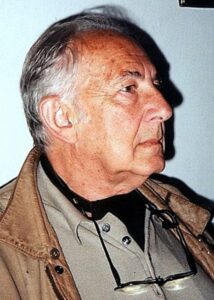
In Their Own Words
Humour
“A systems theorist is a person who spends his life trying to find a sufficiently complex map for a territory that he has already lost.”
Jung was fond of a variation of this old Central European intellectual joke. He used humour as a tool for “intellectual hygiene.” He believed that if a scientist couldn’t laugh at the limitations of their own models, they were in danger of becoming a “closed system” themselves which, in his professional view, was a state of intellectual death.
Professional Activities
In 1952, while studying at the University of Oslo (Norway), Richard Jung discovered systems science through Ludwig von Bertalanffy’s Problems of Life. This revelation provided a unified framework for his interests in biology, psychology, and sociology. Jung went on to revolutionize the field by transforming abstract social theories into rigorous, “engineered” models, bridging the gap between sociology and cybernetic precision.
His central contribution was the formalization of “The Human System,” a multi-level hierarchy that modeled human beings as self-regulating systems processing energy, information, and values. By applying cybernetics to Talcott Parsons’ structural-functionalism, Jung reimagined social order as a dynamic process of “steering” and feedback loops. He introduced formal rigor through “wired” schematics that were complex functional diagrams mapping the internal mechanics of human action.
Jung also humanized systems science by integrating phenomenology, arguing that intent and meaning are vital systemic variables. A proponent of cross-scale isomorphism, he maintained that the same structural laws govern everything from cells to civilizations. As a leader in the International Society for the Systems Sciences he acted as a gatekeeper for scientific depth. Jung’s legacy resides in his “analytical maps” as circuit diagrams that connect biological necessity to social aspiration, providing a comprehensive visualization of the invisible forces governing human behavior.
Contributions To Canada’s Systems Thinking Literacy
- Institutional leadership: Established the Center for Systems Research at the University of Alberta, creating a vital hub for international collaboration and academic study.
- Interdisciplinary mentorship: Integrated cybernetics, sociology, and biology to train researchers in addressing complex social and technical problems through a wholistic lens.
- Systems philosophy: Expanded the field beyond technical data to explore philosophical and ethical dimensions, influencing how human behavior and policy are conceptualized.
- Applied literacy: Improved national systems literacy by translating complex concepts for practitioners in management, planning, and community development.
- Global integration: Connected Canadian scholarship with global networks, ensuring the nation remained at the forefront of adaptive, nonlinear problem solving.
Did Richard’s work positively influence Canada’s K-12 education, directly or indirectly?
Richard Jung’s influence on Canadian K-12 education is foundational but invisible, primarily acting through the transition from linear teaching to systems thinking.
- Curriculum integration: His work in Systems Synthesis provided the theoretical framework for modern interdisciplinary curricula, moving education away from isolated subjects toward a model where students analyze how social, ecological, and technological systems interact.
- Shift to competency-based learning: Jung’s focus on General Systems mirrors Canada’s move toward Core Competencies. This prioritizes high-level cognitive skills like synthesis and critical analysis over the rote memorization of facts.
- Inquiry-based pedagogy: By championing cybernetics (the study of feedback loops), Jung’s logic supports modern inquiry-based learning, where students investigate complex big picture problems rather than linear cause-and-effect.
- Institutional influence: As a senior academic at the University of Alberta, he helped shape the intellectual climate that trained decades of Western Canadian educators and curriculum designers, embedding systems logic into the DNA of provincial school systems.
Contributions To The Global Systems Thinking Discipline
Richard Jung’s contributions to systems thinking are defined by his transformation of abstract social theories into rigorous, engineered models effectively bridging the gap between grand sociology and the mathematical precision of cybernetics. By formalizing “The Human System” as a multi-level hierarchy, Jung developed a unified schematic language that integrated biology, psychology, and culture into a single self-regulating framework. He famously evolved Talcott Parsons’ static structural-functionalism into a dynamic cybernetic process, reimagining social categories as active feedback loops focused on continuous steering and error correction.
Jung introduced a unique formal rigor through complex “wired” schematics that were functional block diagrams that mapped the internal mechanisms of human action, including inputs, throughputs, and outputs. Notably, he integrated phenomenology into systems science, arguing that subjective experiences like meaning and intent could be modeled as systemic variables. This approach humanized the field, proving that consciousness is not separate from systemic logic. Furthermore, his work emphasized cross-scale isomorphism, asserting that the structural laws governing biological cells are fundamentally similar to those governing global civilizations. As a leader within the International Society for the Systems Sciences , Jung preserved the intellectual rigor of the movement, ensuring systems thinking remained a disciplined scientific pursuit. Ultimately, his legacy lies in providing the “circuit diagrams” for human behavior, mapping the invisible threads that connect biological necessity to our highest social aspirations.