

In Their Own Words
Humour
“If you torture the data long enough, it will confess to anything.”
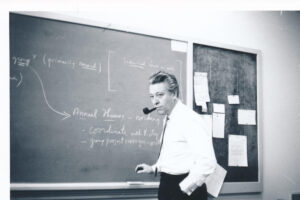
While this quote is often attributed to Ronald Coase, Royce used it frequently in his lectures to warn students against “blind factor analysis.” Royce categorized people by their “Epistemic Styles” (Empiricism, Rationalism, and Metaphorism). He privately joked that the Metaphorists (the artists and poets) had the most fun, while the Empiricists (the data-driven scientists) were the most likely to have an ulcer because they were constantly trying to find a “fact” that didn’t exist. Like Richard Jung and Bertalanffy, Royce viewed humor as a necessary release valve for the “intellectual cramp” caused by trying to solve the mystery of human consciousness.
Professional Activities
Joseph R. Royce was a distinguished figure in theoretical psychology at the University of Alberta, where he served as a professor and the founding director of the Center for Advanced Study in Theoretical Psychology. Established in the mid-1960s, the Center became a premier international hub under his leadership, hosting the influential “Banff Conferences” that gathered multidisciplinary experts to explore the conceptual foundations of psychology.
Royce’s primary research focused on the theory of individual differences through the lens of multivariate experimental psychology. Utilizing complex factor analysis, he sought to map the intricate structure of human individuality by integrating cognitive, affective, and sensory factors into a unified framework. Central to his work was the application of General Systems Theory to the human mind; he moved beyond simplistic stimulus-response models to view the psyche as a hierarchical, organized system of traits.
A major milestone of his tenure was the development of the “Multi-Factor Theory of Individuality,” which categorized personality and intelligence into sub-hierarchies and examined how unique styles (conceptual, empirical, metaphorical) influence information processing. Beyond his research, Royce was a prolific academic leader and editor, notably for the Newsletter of the International Society for Theoretical Psychology and volumes such as “Toward Unification in Psychology” Through his extensive mentorship of doctoral students and his dedication to publishing, he cemented the University of Alberta’s reputation as a global destination for theoretical psychological study.
Contributions To Canada’s Systems Thinking Literacy
- Founding theoretical centers: He established the Center for Advanced Study in Theoretical Psychology at the University of Alberta (1960), a global hub for interdisciplinary systems thinking.
- Multivariate Systems Theory: Royce developed a comprehensive “multi-factor-system” theory of individuality, modeling the human psyche as a complex hierarchy of interacting subsystems (cognitive, affective, and sensory).
- Epistemic literacy: He introduced the concept of “psycho-epistemology,” using systems frameworks to explain how humans integrate different ways of knowing (empiricism, rationalism, metaphorism).
- Interdisciplinary leadership: Through his chairmanship and publications, he championed the “systems approach” as a way to unify fragmented scientific disciplines in Canada.
Did Joseph’s work positively influence Canada’s K-12 education, directly or indirectly?
Joseph R. Royce’s influence on Canadian K-12 education was primarily indirect, exerted through his leadership at the University of Alberta and his impact on the training of educational psychologists and administrators.
- Teacher training and educational psychology: As a foundational figure in Western Canadian psychology, Royce’s Multifactor-System Theory influenced the curriculum for graduate students who became school psychologists and counselors. This shifted the focus toward viewing students as integrated systems rather than isolated sets of behaviors.
- Wholistic learning frameworks: His Ways of Knowing (Empiricism, Rationalism, and Metaphoraphorism) aligned with and supported the shift toward multi-modal learning in Canadian curricula, encouraging educators to value artistic and intuitive metaphoric intelligence alongside logic and math.
- Validation of individual differences: His systemic approach provided a theoretical basis for differentiated instruction in public schools, emphasizing that K-12 systems must adapt to the unique cognitive and affective subsystems of the individual child.
- Institutional leadership: By founding the Center for Advanced Study in Theoretical Psychology, he made Alberta a hub for systems thinking, which trickled down into provincial educational policy regarding how cognitive development is assessed in public schools.
Contributions To The Global Systems Thinking Discipline
Joseph R. Royce was a pioneer at the University of Alberta in applying General Systems Theory to the human mind, challenging the reductionist models common in mid-20th-century psychology. He proposed that the psyche is not a collection of isolated traits but a complex, hierarchical system of interacting subsystems, including cognitive, affective, and sensory components. By viewing personality through this “systems architecture,” Royce enabled researchers to understand how shifts in one psychological area could ripple through the entire system.
A key aspect of his work involved conceptualizing “factor genealogies.” Using multivariate factor analysis, he mapped psychological traits as interconnected nodes within a systemic taxonomy, illustrating how intelligence and personality are organized into levels of increasing complexity. Royce also integrated cybernetic principles, such as feedback loops and self-regulation, framing the “self” as an active, self-organizing system rather than a passive recipient of external stimuli.
Furthermore, Royce introduced the concept of “epistemic styles,” arguing that individuals process reality through systemic filters, specifically the empirical, conceptual, and metaphorical styles which dictate how their psychological system validates information. Through his leadership at the Center for Advanced Study in Theoretical Psychology and the influential Banff Conferences, he used systems thinking as a meta-language to unify fragmented disciplines like biology and philosophy. Ultimately, Royce’s tenure at the University of Alberta transformed the institution into a global centre for psychological unification, driven by his belief that a systemic, overarching theory was essential for the field’s scientific viability.
AI generated and reviewed with multiple brands