

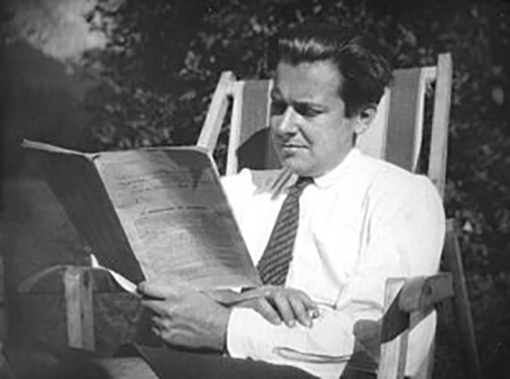
In Their Own Words
Humour
“The specialist is a man who knows more and more about less and less, until he finally knows everything about nothing.”
Similar versions of this joke existed in his time and Bertalanffy used it frequently in his lectures to justify the need for Generalists and Systems Theory. Bertalanffy saw humour not as a triviality, but as a biological indicator of human freedom. It was the proof that we are not just biological machines, but symbolic creators who can see the irony in our own existence.
Professional Activities
Ludwig von Bertalanffy was a multifaceted polymath whose professional life bridged biology, philosophy, and social science. As an organismic biologist, he challenged the era’s prevailing views by rejecting both mechanistic reductionism and vitalism. Instead, he proposed that organisms be understood as integrated wholes, a perspective that led to the development of the von Bertalanffy Growth Function, which remains a staple in biological modeling today.
Beyond theoretical work, Bertalanffy was an influential academic and institutional leader. He held prestigious professorships at the Universities of Vienna, Ottawa, Montreal and Alberta, as well as SUNY Buffalo. In 1954, he co-founded the Society for General Systems Research (SGSR) cementing systems science as a formal discipline. His diverse research even extended to oncology at Mount Sinai Hospital, where he developed cytological techniques for cancer diagnosis.
In his later years, Bertalanffy transitioned into a philosopher and social critic. He vocally opposed the robot model of humanity found in behaviorist psychology, arguing that humans are active, symbol-creating beings. By integrating these various roles, Bertalanffy established a wholistic scientific paradigm that continues to influence contemporary thought across multiple disciplines.
Contributions To Canada’s Systems Thinking Literacy
- Helped seed Canadian systems scholarship. Bertalanffy’s ideas spread through Canadian universities, especially in biology, psychology, and management, where scholars began using systems language more openly.
- Influenced Canadian interdisciplinary research. His emphasis on wholes, relations, and feedback encouraged scholars to connect environmental, social, and organizational issues rather than study them separately.
- Strengthened systems thinking in public policy. Canadian planners and policy thinkers used his ideas to think more holistically about health care, education, cities, and resource management.
- Supported Canadian environmental thinking. His view of organisms as part of larger systems fit well with Canadian concerns about ecology, conservation, and the management of large natural regions.
- Raised Canada’s systems literacy. By helping make systems theory familiar in Canadian academic and professional circles he contributed to a broader Canadian ability to analyze complex problems.
Contributions To The Global Systems Thinking Discipline
Ludwig von Bertalanffy rejected both mechanism and vitalism, arguing that neither reductionism nor mystical forces could adequately explain life. Instead, he developed General System Theory rooted in his “organismic biology” of the 1920s and presented at a 1937 University of Chicago philosophy seminar that became cited as the birth of systems science. Although he preferred the term Science of Wholeness that he coined in 1945 he eventually settled on General System Theory as his work gained international traction after moving to North America in the late 1940s.
“Biological systems are stratified with a hierarchy of levels of organization from living molecules to multicellular individuals and supraindividual aggregates. The whole of nature is a tremendous architecture in which subordinate systems are united at successive levels into ever higher and larger systems.”
Bertalanffy’s core premise was that nature is a tremendous architecture of stratified levels, ranging from molecules to complex social aggregates. He proposed that laws governing open systems, which exchange matter and energy with their environment, apply universally across physical, biological, and sociological domains. By focusing on principles such as feedback, equilibrium, and self-organization, he sought to unify fragmented scientific disciplines into a cohesive whole. His life’s work culminated in the 1968 publication of General System Theory: Foundations, Development, Applications cementing a wholistic paradigm that remains influential today.