

Frequently Asked Questions About Systems Thinking
What is a system?
“A system is a collection of parts that work together to achieve a common goal. The parts can be physical objects, activities or ideas.”
Where did the word system come from?
The modern word system comes originally from the Ancient Greek word sustēma meaning “organized whole”. The word sustema (σύστημα ) came together from the words sun – which meant “with, together” and histanai which meant “to cause to stand” or “set up”. The ancient Greek language existed between 1500 and 300 BC.
The Oxford English Dictionary’s first recording of the word system is in the 1580s. It was noted slightly later in the early 1600s as the French word systeme, and the Late Latin word systema. At that time it meant “the whole creation, the universe” possibly in association with the developments in astronomy at the time. For almost the next 400 years, use of the word system remained low as it gradually expanded into new subjects of study. Over time it accumulated 31 meanings in 15 different fields beginning in music, ancient Greek history, astronomy, literature, and later anatomy, plant physiology, taxonomy, prosody, hairdressing, betting, crystals, geology, weather, metal industry, and most recently in computing.
A significant rise in its use occurred around 1960 with the appearance of the System Sciences (Systems Thinking) discipline itself. This included the developing principles of General Systems Theory (GST) over several decades and also of systems thinking methods being integrated into the academic study of many existing disciplines.
What is systems thinking?
Systems thinking is a way of understanding systems by looking at the relationships between the parts of the system rather than the parts themselves. By using a systems thinking approach people can explore and develop effective actions in complex situations.
Who coined the term systems thinking?
Barry Richmond is credited with coining the term systems thinking in 1987. Barry lived in the period of the 20th century when a cluster of academic pioneers were rapidly expanding the theoretical foundation and applications of the young Systems Sciences discipline. As a student of Jay Forrester, the named founder of System Dynamics, Barry was applying Jay’s novel stock-and-flow diagramming language to build numerical models that were integrating the physical and social elements of a situation. Barry drew academic attention to the visual simplicity and enormously wide applicability of stock-and-flow symbols describing them as a common language (lingua franca), an Esperanto, capable of “making thinking visible” to others.
Barry named a series of twelve systems thinking skills forming a problem-solving method that remains one of the widely accepted approaches to thinking about systems. He also introduced the term global systems thinking citizen as he envisioned a world-wide community of systems thinkers.
Here is Barry Richmond’s definition of systems thinking:
“Systems Thinking is the art and science of making reliable inferences about behavior by developing an increasingly deep understanding of underlying structure”.
Are there similarities between Systems Thinking, Critical Thinking and Design Thinking?
Yes! Systems Thinking, Critical Thinking, and Design Thinking all arose through the 20th century. Each was inspired by a small group of multidisciplinary thinkers who were themselves from diverse educational backgrounds. All three schools teach learner-centred methods that help people build common thinking skills with greater self awareness of their own thinking process. And enable people to witness their thinking more rigorously through self reflection, an activity called metacognition or meta-thinking.
Is there affinity between Design Thinking, Critical Thinking and Systems Thinking?
Systems Thinking, Critical Thinking, and Design Thinking complement each other very well when faced with multifaceted challenges. Systems Thinking teaches methods identify and piecing together the elements of a situation that together create a meaningful whole. Critical Thinking uses analytical tools to evaluate ideas and evidence. Design Thinking guides innovation through empathy and creative problem solving. Together these thinking skills build our creative and analytical capabilities, enhance our overall thinking potential, and strengthen our generalist thinking skills over time by applying them across disciplines!
Trace your personal journey through Systems Thinking, Critical Thinking and Design Thinking!
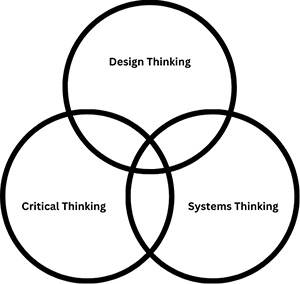
This diagram is a static representation of what is really a dynamic relationship between Systems Thinking, Critical Thinking and Design Thinking. If you place yourself at any starting point in this diagram you can mentally trace your personal journey through your preferred regions of the diagram. While everyone’s path is unique and can at times feel like an emotional roller coaster, there are several signposted intersections where you can relax and enjoy being with others, to remind yourself that you are never really alone on your journey!